
Hiking coastal trails and reading tide tables
How to plan and hike coastal and beach trails safely: why tides matter, reading a tide table, timing headlands and tidal restrictions, sneaker waves and moving logs, footing on rocks, sand and kelp, visiting tide pools gently, camping on the coast and what to pack for a shoreline hike.
By the CampTier team · Updated 2026-10-15 · About 5 min read
Why coastal hiking needs its own planning
Coastal trails offer some of the most memorable hiking anywhere: sea stacks, tide pools, wildlife and the sound of the surf. They also come with hazards that inland hikers rarely face. The ocean moves on a schedule, twice a day on most coasts, and a beach that is wide and easy at low tide can disappear under water a few hours later. Waves, slippery rocks and drifting logs add risk.
This guide covers how to read a tide table, plan around tidal restrictions and hike safely along the shore. It is general guidance; coasts vary enormously, so check the rules and safety information for the park or beach you plan to visit, and ask rangers about current conditions.
How tides work, in brief
Most coasts have two high tides and two low tides roughly every day, though some places have only one of each, and the times shift later from one day to the next. The height of the tide also changes through the month. Around new and full moons, tides tend to have a bigger range, with higher highs and lower lows. Weather matters too. Olympic National Park warns that strong winds and storms can make tides higher than tide charts indicate, sometimes making normally passable routes impassable.
Reading a tide table
A tide table lists the times and predicted heights of high and low tides for a specific location. In the United States, NOAA publishes tide predictions online, and visitor centers and ranger stations in coastal parks often have printed tide charts.
When you read one:
- Choose the right station. Tide times can differ noticeably between nearby locations. Use the station closest to where you will hike.
- Note the date and time zone, including daylight saving time.
- Look at heights, not just times. A low tide of 4 feet may not uncover the same beach as a low tide of 1 foot or below zero.
- Note both low tides in a day, since one may be much lower than the other and one may fall at night.
Tidal restrictions and headlands
On many coastal routes, rocky points or headlands can only be rounded on the beach at lower tides. Some can never be rounded safely. Olympic National Park's wilderness coast guidance explains that some headlands require low tides for passage and some can never be rounded safely even at the lowest tides, so overland routes must be used.
To plan around restrictions:
- Get a detailed map that shows tidal restrictions and the tide height at which each point becomes hazardous. Olympic recommends carrying both a topographic map with these markings and a tide chart.
- Mark each restriction on your route and the tide height it needs.
- Compare with the tide table for your hiking dates to find the windows when each point is passable.
- Time your crossings. Olympic advises that the safest time to round headlands is within one to two hours before low tide, and that rounding a headland on an incoming tide can be dangerous.
- Carry a watch or check the time often, and leave a margin for slow going.
Remember that on the same low tide, you may be able to round one point but not the next. If you are not sure you can make it safely, wait for the next low tide or turn back. Getting trapped against cliffs by a rising tide is a real danger.
Waves, logs and other shoreline hazards
- Keep watching the water. Large waves can arrive unexpectedly, even on calm days. Avoid turning your back on the ocean, especially on steep beaches and rocky ledges.
- Stay off drift logs in the surf zone. Olympic warns that waves can move beach logs, which can crush and kill.
- Avoid swimming in cold, rough water with strong currents and hidden rocks unless the area is designated and conditions are safe.
- Watch for unstable cliffs and bluffs. Do not climb on them or sit at their base.
- Check stream crossings. Creeks and rivers reaching the sea can be deeper at high tide and after rain. See crossing streams safely on hikes.
Footing on the beach
Beach hiking is slower than most people expect. The surface can change from hard sand to soft sand, gravel, cobbles, boulders and big drift logs within a short distance. Olympic's guidance notes that algae-covered rocks and wet logs can be slippery and unstable, and suggests staying low, taking short steps and keeping your hands free for balance. It also notes that its wilderness coast terrain usually limits even strong hikers to five to ten miles a day.
Footwear with good grip and flexible soles helps on wet rock. Expect your feet to get wet and sandy, and bring dry socks. See choosing hiking footwear.
Visiting tide pools gently
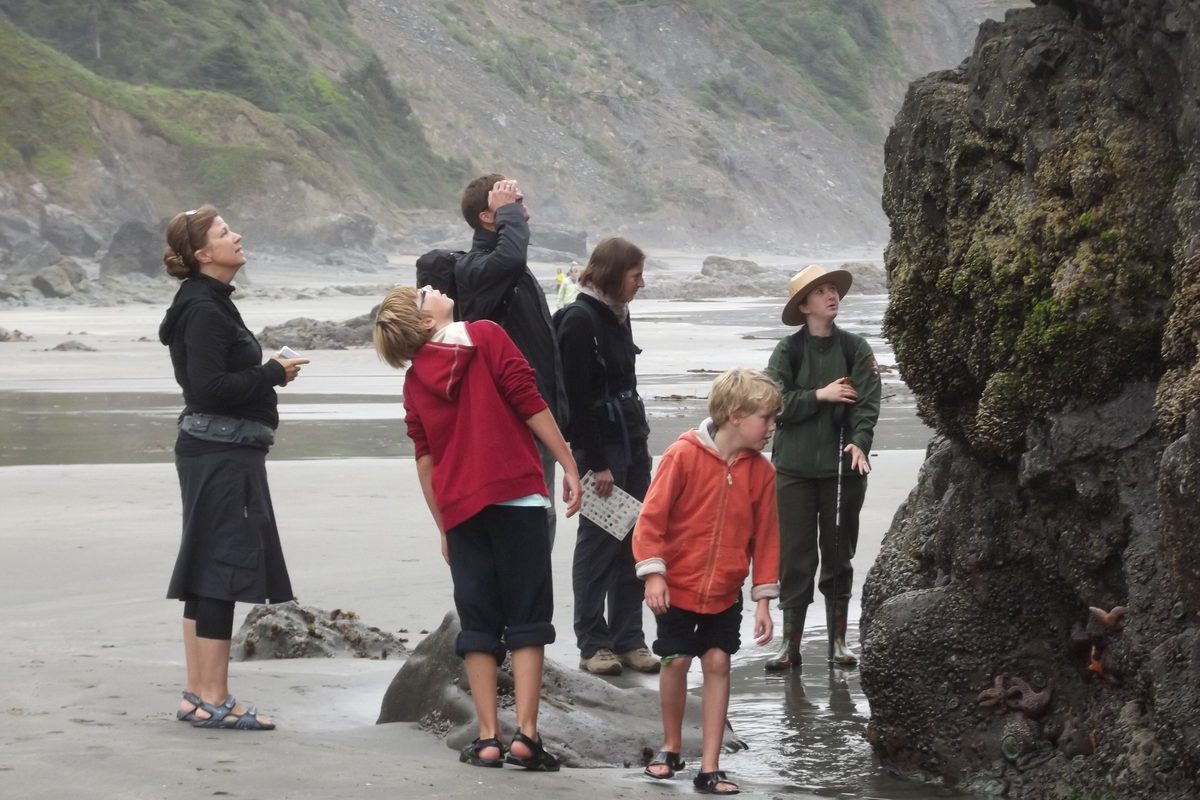
Low tides uncover tide pools full of sea stars, anemones, crabs and other animals. Enjoy them carefully:
- Step on bare rock or sand, not on animals, plants or seaweed.
- Look but avoid touching or picking up animals. Olympic notes that human handling can be harmful and sometimes fatal to tide pool animals.
- Leave shells, rocks and creatures where you find them. Collecting is restricted in many parks.
- Keep an eye on the tide so you are not cut off while exploring.
- Join a ranger-led program if one is offered.
Camping on the coast
Beach and coastal camping needs extra care with tides. Camp well above the high tide line and any debris lines left by storms. Follow food storage rules, which can be strict on wilderness coasts; Olympic's coastal trail conditions page notes that food, garbage and scented items must be stored in approved bear canisters along its wilderness coast. Expect wind, fog and rain. Our guide to beach camping basics covers more.
What to pack
- A current tide table and a map showing tidal restrictions
- A watch or phone with the correct time
- Rain gear and warm layers, since coasts can be cool and damp; see rain gear for camping
- Sturdy footwear with good grip
- Extra socks
- Water and a way to treat it
- Sun protection, since reflected light off water and sand adds up
Bottom line
On the coast, the tide sets your schedule. Use a local tide table and a map that shows tidal restrictions, cross headlands on a falling tide, leave a margin and turn back if in doubt. Watch for big waves and moving logs, step carefully on wet rocks and treat tide pools gently.
Filter hiking boots by spec → Compare up to 3 →
Related guides
- Beach camping basics: tides, wind, sand and sun
- Crossing streams safely on hikes: when to cross, how to cross, and when to turn back
- Reading topographic maps for day hikes
- Choosing Hiking Footwear: Boots, Mid Hikers and Trail Shoes
- Rain Gear for Camping
General guidance from CampTier, based on manufacturer instructions and common outdoor practice. We don’t claim hands-on testing. Always follow your gear maker’s care and safety instructions. See our safety notes.